Book Rec: Winning Without Persuading, by Esther Choy
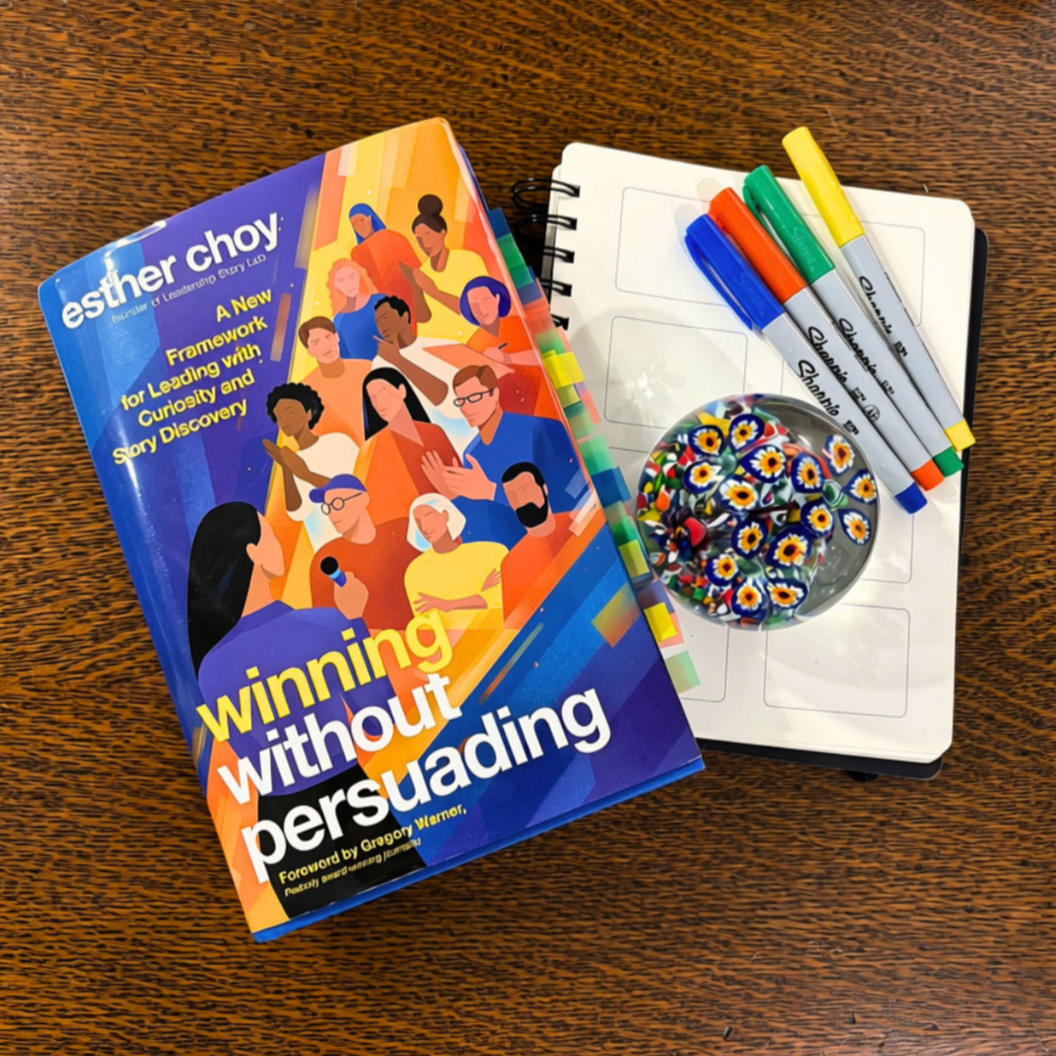
Winning Without Persuading:
A New Framework for Leading with Curiosity and Story Discovery
by Esther Choy
“Metaphor helps us remember the heart of something.”
When Eve L. Ewing said that last year, at a book talk for Original Sins at the American Writers Museum (see earlier post here), I furiously typed it into my Notes app. I felt both delighted and validated by her words, as I work and walk through the world as a highly analogical thinker who [sometimes obsessively] relates to people and things through metaphors, analogies, similes, and stories. (So many stories!)
I was again delighted, when reading Esther Choy’s latest, Winning Without Persuading, as she writes that “stories are not just trumpets to polish résumés or proclaim power but vessels to hold values, preserve community, and carry meaning across generations.” One of many things Choy does so deftly throughout this book is provide tools to take our and, very importantly, others’ stories deeper to make meaningful connections, while she simultaneously proves the point that those deeper connections are what so often truly “win” us the big job, the big gift, the big contract.
While we may naturally have an underlying agenda, or at least a desired outcome, for any given conversation, Choy demonstrates how to both tell and evoke stories from places of generosity and responsiveness. At one point, she shares a story of her own where she realized she could go “from ‘How can I impress?’ to ‘What does this audience need from me?’” in describing how she facilitated story-filled conversations with and among prospective students during her time as an MBA admissions officer. Choy shows us that when we practice mutuality in purposeful storytelling, we not only benefit everyone in the conversation, we also take the conversation much further than a lopsided pitch or de facto interview ever could.
I happen to know Esther beyond my bookshelf (in leadership life we share membership in Northwestern’s Council of One Hundred), and I consistently find her enthusiasm infectious and her curiosity genuine. As in her book, she models how a leader being both self-assured and “Other Centric” are neither mutually exclusive nor in conflict. Rather, they are traits and practices that amplify each other.
Read Winning Without Persuading If You Want or Need to:
Learn more about how to help other people–from your immediate team members to your business and/or impact partners–tell their stories, which will also make you better at telling your own.
Build up your practical skills as a facilitator. Choy’s book, (especially Chapter 7, about “what great facilitators know that most leaders miss”) could be a satisfying companion to Paolo Freire’s Pedagogy of the Oppressed and bell hooks’ Teaching to Transgress.
Gain straightforward tools, including but not limited to: a three-piece storytelling model, powerful questions to ask others, and frameworks for common business storytelling plots. I finished the book a few days ago and have already used what I learned in both coaching sessions and curriculum design.
Read a leadership primer on storytelling that walks its talk, not only in its use of story to demonstrate concepts but in its critical lens on when and how storytelling is used for unsavory, oppressive, or otherwise immoral ends.