Book Rec: Calling In, by Loretta J. Ross
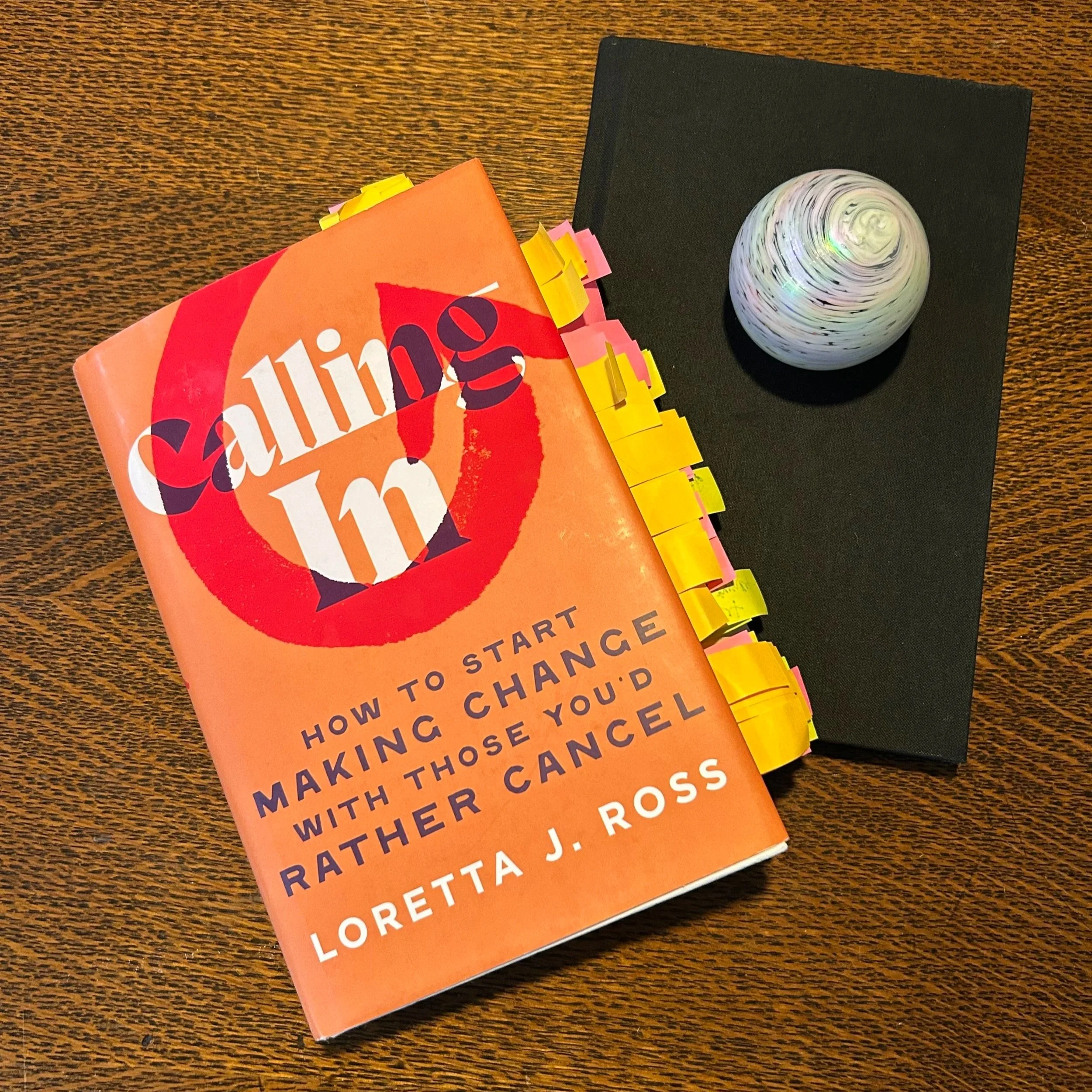
Calling In:
How to Start Making Change with Those You’d Rather Cancel
by Loretta J. Ross
Even after many years of careful experiments, I still use the word “love” in professional settings with some caution. On one hand, my own coaches have helped me shape my highest aspiration for my professional identity as a coach and consultant to be “advancing a professional practice of love.” On the other hand, I still have deep-seated, factory-installed parts of me that pop up to warn me of scaring people away with talk that may be misconstrued as rainbows-and-butterflies fluff against a background of nuts-and-bolts, bulls-and-bears, clicks-and-mortar businesses.
So I was thrilled when I read Loretta J. Ross’ definition of “calling in” in her book of the same name. She writes that “a call in is a call out done with love.” While we likely each have our own shorthand definition (and experience) of a call out, Ross breaks down the “anatomy of a call out,” which can include (1) a presumption of guilt, (2) abstraction (see also ladder of inference), and (3) essentialism (what someone said/did becomes who they are), among other elements.
She explains that with a call in, as with a call out, “the harm is not ignored, because we don’t want the harm to continue” and “in choosing to call in, our response is contoured by love instead of anger.” Ross’ work, Calling In: How to Start Making Change with Those You’d Rather Cancel is almost certainly the book I recommended to friends and colleagues most in 2025 (even though I didn’t read it until late September).
Ross’ words have now joined other favorite quotations that bring love into constructive conversation and serve as deep touchpoints for collaboration, design, and decision-making:
“Justice is what love looks like in public.” – Dr. Cornel West
“Boundaries are the distance at which I can love you and me simultaneously.” – Prentis Hemphill
“We can disagree and still love each other unless your disagreement is rooted in my oppression and denial of my humanity and right to exist.” – James Baldwin
When we work with teams and organizations on strategy and/or organizational effectiveness work, we often talk about a goal of gaining commitment over finding consensus. We want our strategies to have teeth, our plans to have action, and we want at least a little bit of risk and tension because only dead things are free of risk and tension. Commitment can give us those, where consensus often waters our work down or threatens to make us a groupthink army. What Ross, as a longtime leading human rights activist and reproductive justice movement leader, says is that “when many people have different ideas but move in the same direction, that’s a movement. When many people have the same idea and move in the same direction, that’s a cult.” While our team or organization doesn’t necessarily need to be a movement, we certainly need to make movement happen to accomplish our goals for impact.
While this book may most readily appeal to those who identify as doing or being in justice work, the lessons apply to all kinds of work we do with people. If you have people working together, you have conflict. And hopefully you have learning. Hopefully you have each of those without punishment. As Ross writes, “an environment—online or in-person—that’s riddled with call outs offers no room for learning. There’s no room for trial and error if the first error puts you on trial.”
Read This Book If You Want or Need:
Want tangible, effective, and realistic strategies and tactics for calling in, from the simple and powerful “tell me more” to buy ourselves time, to a five-point process she walks through in second half of book
Tangible tools for creating a call-in culture—within a meeting, team, or organization (many of which I’ve used previously and can happily attest to their power and effectiveness)
How to find self-compassion, grace, and meaningful action—including actual, tangible steps—to respond to being called in when we inevitably make mistakes
To reflect on when a call out may be necessary, justified, and/or (un)productive and how we decide who we work with (i.e., which differences make a difference)
For all these reasons and more, I’m going to need to read this extraordinary text again in 2026 (and probably at least annually for many years to come).